
By Nadya Aulia Hafsyah & Sahnes Setiara
Abstract
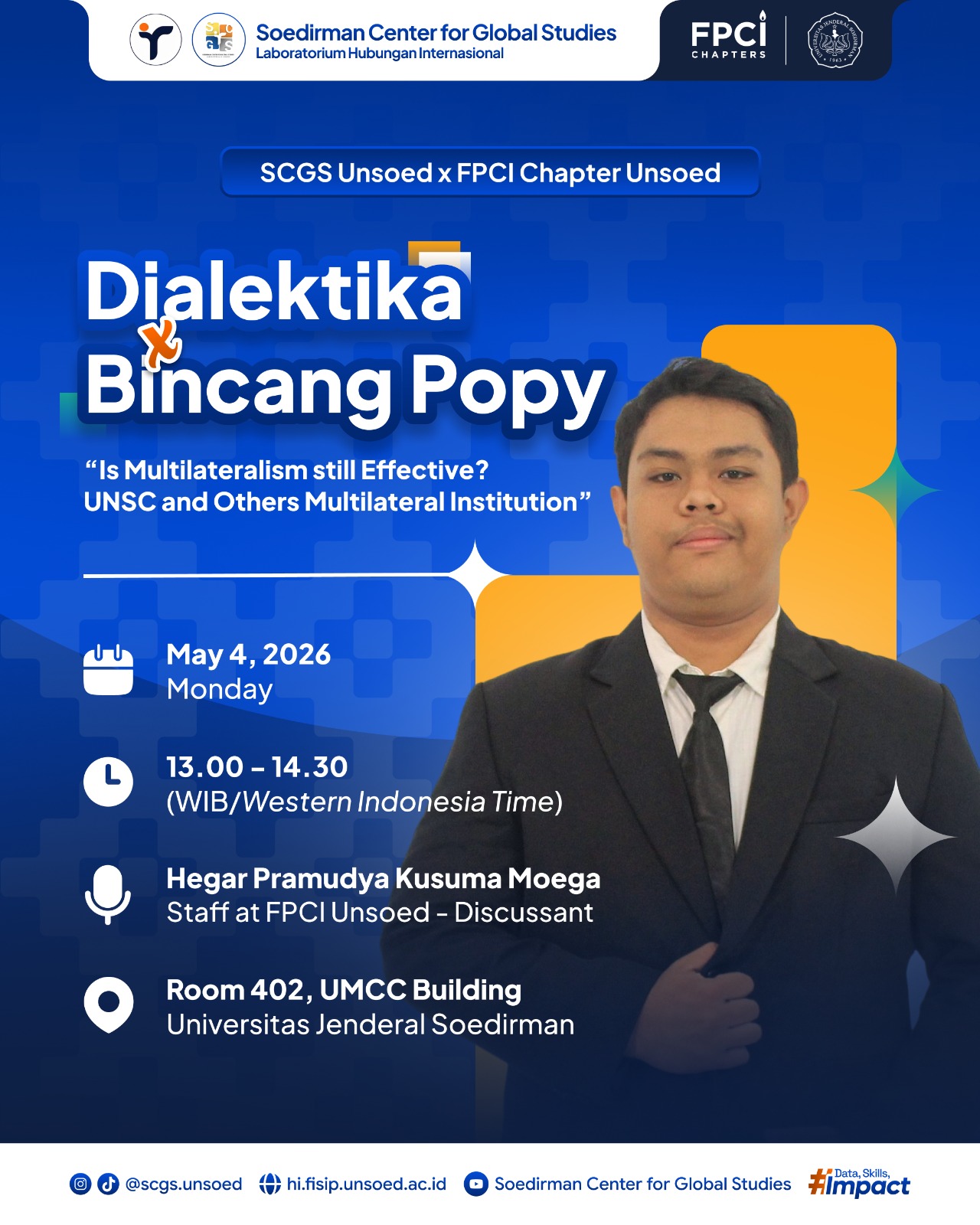
On May 4, 2026, International Relations students and academics convened at the International Relations Laboratory of Universitas Jenderal Soedirman for the “Dialektika Chapter II” discussion, organized by the Soedirman Center for Global Studies. With the primary theme of assessing the effectiveness of multilateralism and institutions such as the United Nations Security Council (UNSC), the discussion initiated by Hegar Pramudya Kusuma Moega dissected the legitimacy crisis currently facing this international organization. The forum highlighted that state responses to the UN’s failures are heavily influenced by historical power asymmetries, clashes of national interests, and a growing trend of fragmentation toward bilateral and regional relations. The forum explored in depth the debate between the urgency of reforming UN institutions and the need to create an entirely new global governance structure amid shifting global political constellations.
The Crisis of Relevance, Legitimacy, and the Failure of the UN Security Council
Hegar Pramudya Kusuma Moega opened the discussion by highlighting that the increasing number of multilateral actions today has ironically triggered geopolitical turmoil across various aspects, particularly originating from the UN Security Council. Hegar emphasized that the UN is facing a crisis of relevance and legitimacy due to numerous violations of international law, with states acting without mandates and moving unilaterally. This has been clearly demonstrated by the Permanent Five (P5) members themselves, as seen in the Iran-US-Israel escalations and the Russia-Ukraine conflict. Hegar argued that the UNSC has failed to curb these cases effectively because the veto power is used only to protect the interests of the holding states. Furthermore, even when a resolution manages to bypass a veto and is intended to be legally binding, its implementation on the ground remains hindered by the compliance levels of UN member states.
In addition, Hegar cited criticisms from several world leaders, indicating a decline in UN legitimacy. The President of Brazil criticized the UN for becoming a source of conflict and allowing conflicts to persist through hypocrisy, while the President of South Africa stated that the veto power is no longer relevant. The President of Ireland also demanded that the UN be fairer and grant larger roles to other nations. Hegar also highlighted the injustice of representation, such as the lack of permanent representation for the African continent in the UNSC. This view of fundamental injustice was strongly supported by Danu. Danu argued that from its inception, the UN system has been asymmetrical and unfair, evidenced by the absence of African representation. Danu assessed that the UN is at its lowest point because, even in the contemporary era, problems remain stagnant; for instance, the ongoing wars, massacres, and famine in Sudan persist without any real solution from the UN. Najib agreed, asserting that injustice stemming from disproportionate power has existed from the start, making it impossible to resolve basic issues like food aid, which continues to stall.
Institutional Reform Options vs. The Formation of a New Body
The discussion then shifted to whether the UN and the UNSC require reform, or whether it is possible to replace the UN with a new entity post-World War II. Ales pointed out that there is currently significant discussion of a Balance of Power (BOP) mechanism that could replace the UN. Ales added that the UN is currently facing a financial crisis, leading to reduced recruitment and cuts in aid funding. According to Ales, the UN’s deviation from its original goal of preventing war, coupled with the emergence of an expanding BOP mechanism (indicated by discourse regarding Donald Trump’s potential lifetime chairmanship), serves as a catalyst for replacing the UN. Responding to Ales, Hegar concluded that the UN’s current position is indeed “on the brink.” Nadya then clarified that the BOP emerging from Resolution 2903 is not a form of multilateralism but leans more toward unilateralism because a single dominant figure remains. Nadya also reminded the forum that the UN budget is heavily influenced by major powers, meaning budget cuts can be used as a threat and a justification for major powers to claim the UN is no longer relevant.
Regarding future solutions, Ales asked the forum whether it is better to reform the existing UN or to establish an entirely new body designed to be fair from the outset. Najib argued that forming a new body would take decades and exhaust enormous budgets. Therefore, Najib prefers the reform option, such as abolishing the veto power, to make the world fairer and more democratic. Najib argued that, ideally, the P5 nations tasked with guarding the world should use their veto power more responsibly.
Danu supported the reform option from a historical perspective. He reminded the forum that the League of Nations failed and led to a devastating war, meaning the formation of the UN was originally paid for at a very high price. Although reform does not guarantee total justice, Danu and Hegar agreed that as long as there are conscious states, reform is the most logical way to minimize costs compared to creating a new body. However, Danu also highlighted the difficulty of passing resolutions (such as on Palestine) because they are constantly vetoed, and achieving fair representation is difficult if even one country rejects them for its own interests. Hegar also noted that recognition for Palestine has yet to find a clear path despite the growing wave of international recognition.
The greatest challenges to reform were voiced by Bintang and Akbar. Bintang doubted whether the P5 nations would be willing to lose their influence by relinquishing their veto rights. Akbar added that it is extremely difficult for the P5 to let go of the veto, as it is one of their primary advantages. Akbar argued that the original purpose of the veto was to maintain balance and cooperation among major powers to prevent war, questioning whether the world would remain safe without it. Sahnes also highlighted the complexity of the veto, noting that it is a right held only by certain parties and cannot be used by others, making it a massive challenge for the world.
Global Governance, Fragmentation, and Regionalism
Mas Dias brought the discussion to a more structural analytical level. He asserted that the veto is not merely a right to cancel an agreement but a form of “exercising power.” Mas Dias observed that if the UN were dissolved, new informal veto mechanisms could emerge that would still compel other countries to comply. Mas Dias highlighted the fragmentation of international law, in which states are increasingly interested in bilateralism and regionalism because they are considered more concrete and easier to implement. He questioned the US stance, which still speaks of multilateralism despite having bilateral relations with almost every country. Mas Dias posed a crucial question: Does the world actually need the institution or the governance? In his view, the existing world order is a product of 1945, and the UN’s relevance depends heavily on the issue at hand because the UN operates in the realm of “high politics,” which is strictly state-centric. He emphasized that global governance remains vital to prevent the threat of total war and nuclear conflict.
Responding to Mas Dias, Akbar agreed that there must still be a physical institution as a vessel because governance cannot function without an institutional form. Hegar questioned how this global governance could be presented and agreed upon simultaneously. Reza added a question regarding how state-centric global governance could coordinate non-state actors, such as NGOs. Nadya agreed on the importance of collaboration with NGOs for inclusivity but questioned whether the UN could still accommodate all interests. Through the lens of realism, Nadya assessed that major powers like the US and China choose bilateral paths because states fundamentally act based on national interest. She also argued that conflict and interest clashes are very possible within multilateralism itself. Reza argued that, in both bilateral and multilateral contexts, the primary goal of state cooperation is to advance national interests.
Regarding regionalism, Sahnes questioned whether regional organizations are truly more effective at keeping the global order safe, noting that even within regionalism, some states are at war. Akbar provided a concrete example, stating that ASEAN is actually as fragmented as the European Union, evidenced by ASEAN’s inability to handle the conflict in Myanmar and the Rohingya crisis. Hegar added evidence of multilateralism’s vulnerability by citing the concrete example of the United Arab Emirates (UAE) leaving OPEC in April. The UAE left because OPEC’s oil production limits harmed their national interest to increase production. Najib predicted that in the future, countries will increasingly lean toward protectionism. However, Ales used the same example to offer a counter-argument. According to Ales, the case of a country leaving actually proves that the world still needs multilateralism. Regarding exploitative issues like the environment, no single country can solve it alone because we live on one earth. Sahnes then suggested the idea of partial reform, in which the UN’s role might be abolished in problematic security areas but maintained on issues like climate change.
Conclusion
Niha summarized the main obstacles to global governance: states fundamentally desire a good image, and the tendency to provide aid is often influenced by that image-building. Niha concluded that it is very difficult to find a truly fair entity to act as world police because the veto holders who are supposed to carry out a special role are always hindered by representation and the priority of their own national interests. To close the session, Mas Dias asked the forum to reflect on a final question regarding whether global governance is important or not. Nadya concluded that this discussion reflects the personal perspectives of each participant; therefore, there is no absolute final conclusion on whether multilateralism is still effective.