
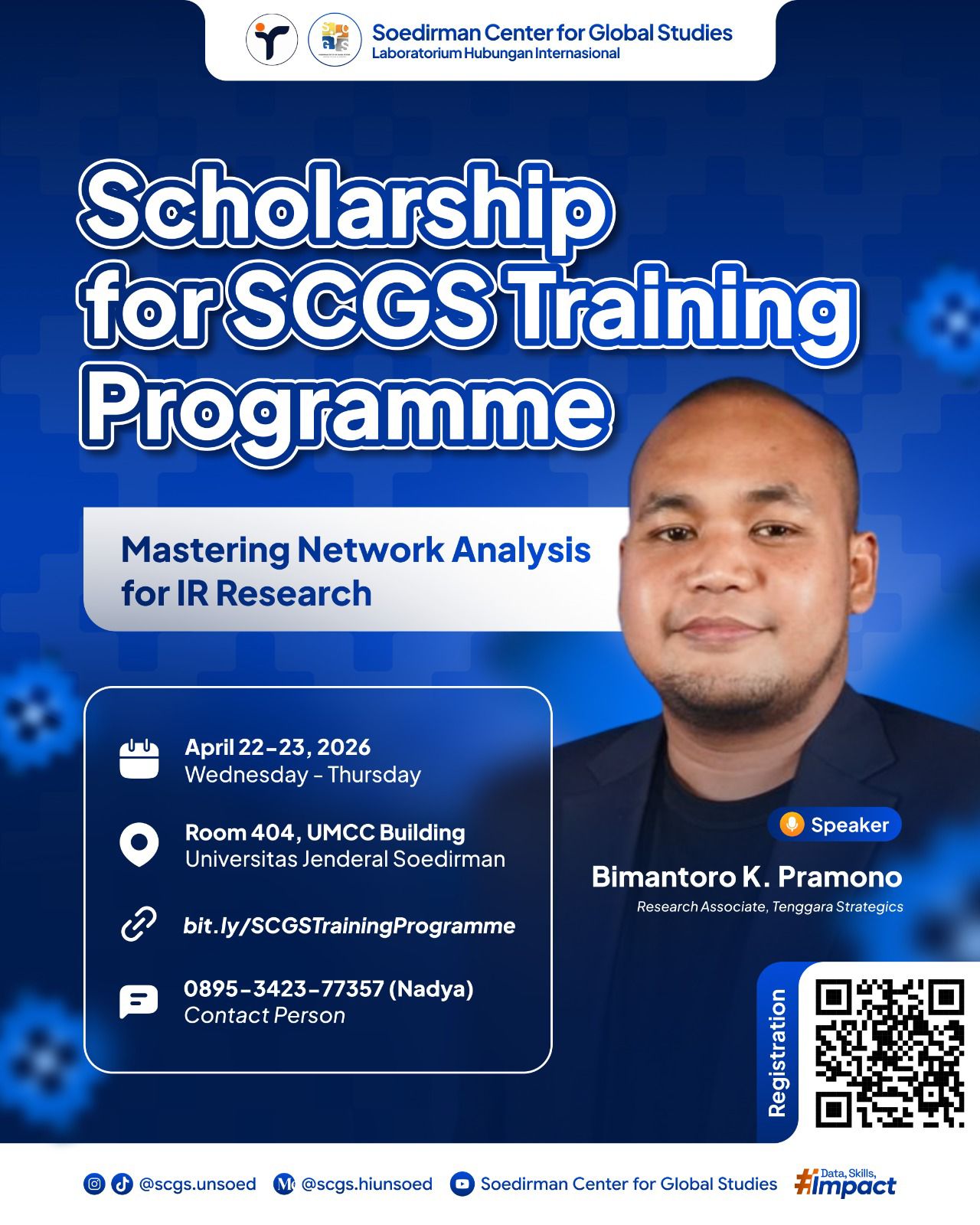
(Muhamad Akbar – Purwokerto) The Soedirman Center for Global Studies (SCGS), a laboratory under the Department of International Relations, Faculty of Social and Political Sciences, Universitas Jenderal Soedirman, successfully held the SCGS Training Program with the theme “Mastering Network Analysis for IR Research” on April 22–23, 2026. This event was held at the Faculty of Social and Political Sciences, Universitas Jenderal Soedirman, and was attended primarily by International Relations students and lecturers.
This event invited Bimantoro Kushari Pramono, a Research Associate at Tenggara Strategic and a lecturer at Universitas Indonesia specializing in network analysis, as a guest speaker. The training focused on introducing network analysis as a methodological approach in international relations studies, using Gephi as a network analysis tool, and applying network analysis to understand global issues.
On the first day, participants were introduced to the basic concepts of network analysis as a paradigm of thought that emphasizes a rational approach to understanding social issues. The presenter explained that, from this perspective, the relationships between actors are key to understanding social structures and international dynamics. Additionally, the presenter discussed important foundational concepts such as the Six Degrees of Separation, the reciprocity of relationships between actors, and the tendency of actors to form groups based on shared values (a principle known as modularity). This approach enables researchers to identify patterns of relationships rather than looking at individual behaviors in isolation.
On the second day, the training continued with a simulation using the Gephi software as a network analysis tool. Participants were guided to understand various metrics in network analysis, such as density to assess network density, modularity to identify clusters, and various types of centrality used to determine the most influential actors within the network. Additionally, participants were introduced to the stages of data analysis, ranging from the analytics process to the interpretation of results, including descriptive, diagnostic, predictive, and prescriptive analyses.
In his explanation, Bimantoro emphasized that network analysis is becoming increasingly relevant in the study of international relations because it can explain the complexity of global interactions, which are no longer linear. This method offers advantages in identifying relationship patterns, key actors, and power dynamics that are often invisible through conventional approaches. Therefore, network analysis is not just a technical tool but also a conceptual framework that helps researchers understand global issues more comprehensively.
The event was conducted interactively, featuring active discussion and Q&A sessions throughout the training. Participants were able to explore both the concepts and practical applications of network analysis in their research. Through this program, SCGS aims to enhance the academic capacity of students and faculty while introducing more innovative research methods in international relations.